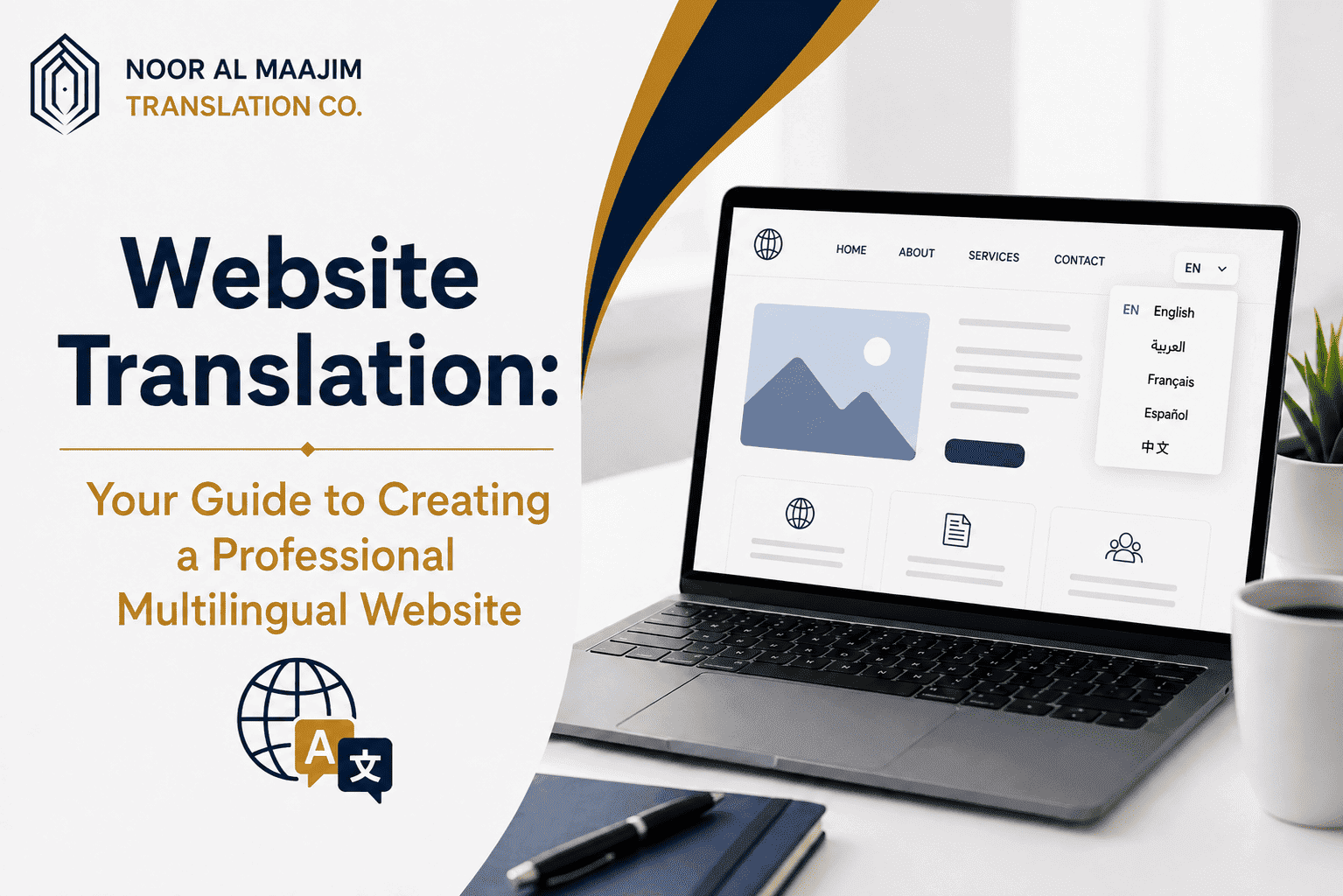
More than 75% of internet users worldwide access content in languages other than English. Yet, around 60% of websites remain available in only one language, meaning thousands of companies are losing valuable business opportunities every day in promising markets they have yet to reach. As local markets become increasingly limited and global competition continues to expand, website translation is no longer a marketing luxury but a strategic necessity for any company aiming for growth and expansion. Whether you manage an e-commerce store in Kuwait, operate a professional services website, or seek to attract foreign investment, having a multilingual website can make the difference between staying local and going global.
Recommendation: Use machine translation as an assisting tool, but do not rely on it alone for commercial or corporate websites. Professional human translation is the ideal choice for websites that aim to build genuine trust with their customers.
What Is Website Translation and Why Is It Important for Businesses?
Website translation is the professional process of transferring all website content from one language to another while preserving its meaning, tone, and cultural context. This process includes translating text, headings, descriptions, products, blog posts, and the entire user interface. However, it goes beyond linguistic translation to include Website Localization, a more comprehensive process that involves adapting dates, currencies, images, colors, and cultural elements to suit the target audience.In Kuwait and the wider Arab region, website translation has become particularly important. Kuwait is a regional financial and commercial hub that attracts investments from around the world, while its startups and major companies compete to attract customers from the Gulf, the Arab world, Europe, and Asia. Your website is your first digital storefront, and if it is not available in the language of a potential customer, you may lose that customer before the conversation even begins.The importance of website translation for businesses can be summarized as follows:- Geographical expansion: Reach new markets without the need to open physical branches.
- Building trust: Customers are more likely to trust a website that communicates in their native language.
- Increasing sales: Multilingual websites can achieve conversion rates up to 70% higher.
- Enhancing reputation: Professional communication in the customer’s language reflects the professionalism of the company.
- Staying competitive: Companies with translated websites can gain an advantage over local competitors.
Why Do Companies Need Website Translation?
There are several strategic and practical reasons why website translation has become a necessity rather than an option:1. Reaching a Wider Audience
More than 420 million people speak Arabic worldwide. If your website is available only in English, you are excluding a huge segment of potential customers across the Gulf and the Middle East.2. Improving User Experience
Users spend more time and interact more effectively with websites that provide content in their native language. Translating digital content can reduce the bounce rate and increase the amount of time users spend on the website.3. Improving Search Engine Visibility
When your website is professionally translated with Multilingual SEO in mind, you increase your chances of appearing in Google search results across different languages, generating more organic traffic.4. Meeting Legal Requirements
In certain sectors, such as healthcare, finance, and education, regulatory authorities may require information to be provided in Arabic or English depending on the target audience.5. Building a Global Brand
Companies that offer their websites in multiple languages establish themselves as professional global brands that value the diversity of their customers.6. Increasing Return on Investment
Website translation is an investment that can generate a fast return by increasing sales and attracting new customers, particularly in emerging markets.What Types of Websites Need Translation?
The need for website translation is not limited to one type of website. It extends across a wide range of industries:1. E-Commerce Websites
Online stores selling products or services need to translate product listings, descriptions, purchasing terms, and return policies. E-commerce website translation can have a significant impact on increasing sales.2. Corporate and Business Websites
Large companies and financial and legal institutions need to translate their corporate information, services, and company news to attract international partners and investors.3. Medical and Healthcare Websites
Hospitals, clinics, and pharmaceutical companies need to translate healthcare information, patient services, and appointment details to serve different communities in Kuwait.4. Educational and Academic Websites
Universities and training centers that attract international students need to translate academic programs, admission requirements, and educational content.5. Government and Public Service Websites
Government entities in Kuwait need to provide their digital services in at least Arabic and English to serve different communities.6. Technology and Software Websites
Software companies and SaaS platforms need to translate user interfaces, technical documentation, and help centers to serve customers worldwide.7. Blogs and Media Websites
Blogs targeting both Arabic and international audiences need to translate their articles to expand their reach and influence.8. Real Estate and Tourism Websites
Real estate and tourism companies in Kuwait targeting foreign investors and tourists need to translate property listings, tours, and booking information.Steps for Professional Website Translation
A professional website translation process involves several carefully planned stages:Stage One: Website Analysis and Audience Identification
Before starting, the website is analyzed to determine the amount of content, number of pages, target languages, and target audience in each market.Stage Two: Extracting Translatable Content
All website text is extracted using specialized tools such as CAT Tools while preserving formatting, links, and images.Stage Three: Professional Translation
The task is assigned to translators specialized in the website’s industry, whether commercial, medical, technical, or otherwise. Translation memory is also used to maintain terminology consistency.Stage Four: Cultural Localization
Dates, currencies, units, images, and colors are adapted to suit the culture of each target market.Stage Five: Multilingual SEO
Title Tags, Meta Descriptions, URLs, and hreflang tags are translated and optimized to ensure proper indexing and visibility in search engines.Stage Six: Review and Proofreading
The translated content undergoes linguistic, terminology, and technical proofreading to ensure it is free from errors.Stage Seven: Testing and Launch
The translated website is tested across different devices and browsers to ensure that all text and elements display correctly before the official launch.The Difference Between Human and Machine Website Translation
| Professional Human Translation | Machine Translation (AI) |
| High accuracy with attention to context and culture | Extremely fast and low-cost |
| Capable of handling specialized terminology | May make mistakes with technical and medical terminology |
| Produces natural and engaging content | May produce robotic and impersonal text |
| Effectively supports Multilingual SEO | Does not fully understand SEO strategies |
| Requires more time and investment | Suitable mainly for general understanding |
| Provides stronger control over data confidentiality | Data may be processed or stored on external servers |
Website Localization vs. Direct Translation
Many people confuse translation with localization, but they are fundamentally different:- Direct Translation: Transferring text from one language to another literally without considering the cultural context.
- Localization: Adapting the content to suit the culture of the target audience, including modifying currencies, dates, units, images, and even colors.
- Display prices in Kuwaiti dinars
- Format dates according to the Gregorian and Hijri calendars
- Use images that reflect Kuwaiti culture
- Support right-to-left (RTL) formatting for Arabic