
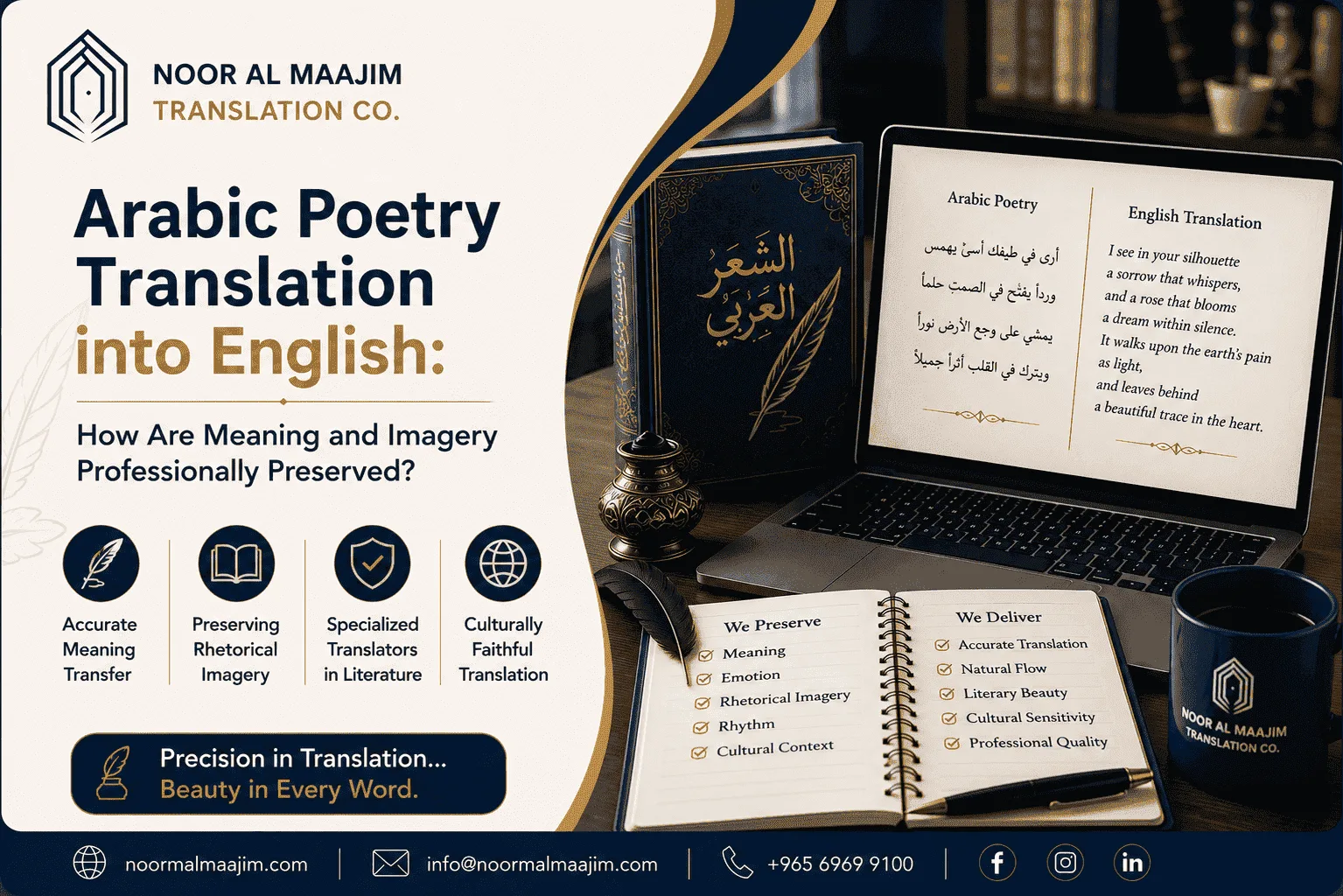
Successful Arabic poetry translation into English goes far beyond replacing Arabic words with their English equivalents. It is a creative literary process that aims to preserve the poem’s meaning, rhythm, imagery, and emotional impact while making it feel natural to English-speaking readers. As global interest in Arabic literature continues to grow, the demand for skilled literary translators capable of conveying the beauty of Arabic poetry has never been greater. At Noor Al Maajim, we provide specialized literary translation services that preserve the spirit of the original poem while ensuring clarity, elegance, and cultural relevance for English audiences.
Why Is Poetry One of the Most Difficult Forms of Translation?
Translation experts widely agree that translating Arabic poetry into English is among the most challenging forms of literary translation. Poetry is not simply informational text it is a carefully crafted artistic composition where sound, imagery, symbolism, and emotion work together. When transferring these elements into a language with a completely different linguistic structure, translators face a fundamental question: should they prioritize the literal meaning or recreate the entire poetic experience? Academic research suggests that professional translators often seek a balance between remaining faithful to the original text and producing a poem that resonates naturally with readers in the target language. A purely literal translation may preserve vocabulary while sacrificing beauty, whereas an overly free translation may drift too far from the poet’s original voice.Linguistic and Cultural Challenges
Structural Differences Between Arabic and English
Arabic possesses grammatical and morphological features that have no direct equivalents in English. Its root-based word system allows multiple meanings and nuances to emerge from a single root, while English relies on a very different linguistic structure. Classical Arabic poetry also employs sophisticated sentence constructions that cannot always be reproduced directly in English.Cultural Context and Symbolism
Arabic poetry reflects centuries of cultural heritage, from pre-Islamic traditions to contemporary literature. Desert imagery, religious references, historical allusions, and Sufi symbolism all require cultural understanding in addition to linguistic expertise. Translating poets such as Mahmoud Darwish, for example, demands deep familiarity with Palestinian history and Arab culture not merely fluency in both languages.Understanding the Target Audience
English-speaking readers often interpret literary expressions differently from Arabic audiences. Metaphors that feel natural and powerful in Arabic may appear unfamiliar or exaggerated in English. A professional translator must therefore adapt cultural references carefully while preserving the poem’s authentic identity.Preserving Rhythm and Figurative Language
Rhythm and Meter
Traditional Arabic poetry follows established metrical patterns that cannot be directly replicated in English. Instead, experienced translators often recreate musicality using alternative rhythmic techniques, English poetic meter, syllabic patterns, or free verse when appropriate.Metaphors and Imagery
Arabic poetry is renowned for its rich figurative language. Images comparing eyes to gazelles or swords, for example, may lose their impact if translated literally. Translators must decide whether to retain the original metaphor or replace it with a culturally equivalent expression that evokes the same emotional response.Repetition as a Stylistic Device
Repetition serves both rhythmic and semantic purposes in Arabic poetry. While repeating words or phrases creates emphasis and musicality, excessive repetition may sound unnatural in English. Skilled literary translators therefore develop creative solutions that preserve the intended effect without compromising readability.Common Approaches to Poetry Translation
Literal Translation
This method attempts to remain as close as possible to the original wording and sentence structure. While it offers high textual fidelity, it often weakens the poem’s artistic quality and emotional impact, particularly when dealing with metaphorical language.Free Translation
Free translation prioritizes meaning and emotional resonance over strict linguistic accuracy. Although it generally produces a smoother reading experience, it may sacrifice some of the poem’s unique stylistic characteristics.Adaptive Translation
Widely regarded as the most balanced approach, adaptive translation preserves the core message and artistic spirit of the original while adjusting linguistic and cultural elements for the target audience. It requires both literary creativity and deep cultural knowledge.Poetic Re-Creation
In this approach, the translator uses the original poem as inspiration to produce a new poetic work. While this method may best capture the emotional essence when direct translation is impossible, it also raises important questions about the boundary between translation and original authorship.Can Poetry Be Translated Literally?
In most cases, the answer is no. Literary scholars generally agree that a word-for-word translation of Arabic poetry into English rarely succeeds. Literal translation often loses the original rhythm, rhyme, symbolism, and emotional power. However, this does not mean literal translation is always inappropriate. Certain simple metaphors or straightforward poetic expressions can be translated directly without losing their intended meaning. Professional translators know when literal accuracy serves the poem and when creative adaptation is necessary.Common Applications of Poetry Translation
Arabic poetry translation into English serves a wide range of professional and cultural purposes, including:- Academic research and comparative literature studies.
- Publishing Arabic poetry collections for international readers.
- Cultural festivals, literary events, and international conferences.
- Translation of Arabic songs and lyrical poetry for artistic collaborations.
- Diplomatic and cultural exchange programs between countries.
How to Choose a Specialized Poetry Translator
Essential Qualifications
When selecting a translator for Arabic poetry translation into English, consider the following criteria:- Proven literary experience: A strong portfolio of literary and poetic translations rather than general translation work.
- Deep cultural understanding: Familiarity with the historical, social, and cultural contexts that shape the original text.
- Creative ability: An excellent poetry translator is, in many ways, a poet who can recreate the artistic experience in another language.
- Multi-stage quality review: A professional workflow involving translators, editors, and cultural consultants to ensure the highest level of accuracy and literary quality.
Questions Worth Asking
Before choosing a translator, consider asking:- Is the translator familiar with the poetic traditions of both Arabic and English?
- Can they provide samples of previous literary or poetry translations?
- How experienced are they in translating different poetic styles, including classical poetry, modern poetry, and prose poetry?
Why Choose Noor Al Maajim?
At Noor Al Maajim, we provide specialized literary translation services, including professional Arabic poetry translation into English. Our team combines advanced linguistic expertise with literary sensitivity to preserve the spirit, artistic style, and emotional depth of every poem while adapting it naturally for English-speaking readers.What Sets Our Services Apart?
- Preserving the literary voice: We maintain the author’s style, tone, and artistic intent while producing fluent English translations.
- Specialized literary translators: Our translators have extensive experience in literary and cultural translation.
- Reliable quality: We deliver high-quality literary translations suitable for authors, publishers, researchers, and cultural institutions.
- On-time delivery: We respect agreed deadlines without compromising quality.
- Complete confidentiality: We safeguard intellectual property rights and maintain strict confidentiality for every project.
Our Poetry Translation Services Include
- Poetry collections
- Literary texts
- Classical and modern Arabic poetry
- Creative and artistic writing